
Your wedding guest list was supposed to be a list. Somehow it has become a family group project with surprise collaborators.
Maybe your mom keeps sending names. Maybe your future in-laws are treating invitations like theirs to distribute. Maybe your parents are paying for part of the wedding and every attempt to say no is met with, “But we’re contributing.” Or maybe you said, “Sure, invite a few people,” and have since discovered that a few is an extremely flexible unit of measurement.
The usual advice here is: “It’s your wedding. Your rules.” Sometimes that is basically the answer. Sometimes it skips the hard part.
If your parents are contributing money, if you explicitly promised them a certain number of guest spots, or if excluding someone carries a real family or cultural consequence, you have a negotiation to handle—not just a boundary slogan to repeat louder.
The useful question is not “Who gets their way?” It is: What was actually agreed, what can the wedding realistically accommodate, and is this still a negotiation—or has the decision already been made?
First, Figure Out Which Guest-List Problem You Actually Have
Before you argue about Cousin Whoever or your dad’s golf friend, stop discussing individual names for a minute.
You need to identify the type of dispute first. Otherwise you can spend an hour arguing about whether one person “deserves” an invitation when the real problem is that nobody ever agreed how many invitations your parents had in the first place.
Use this matrix to find your situation. The labels matter: some rows reflect supported planning guidance, while others are conditional or editorial judgment rather than universal etiquette.
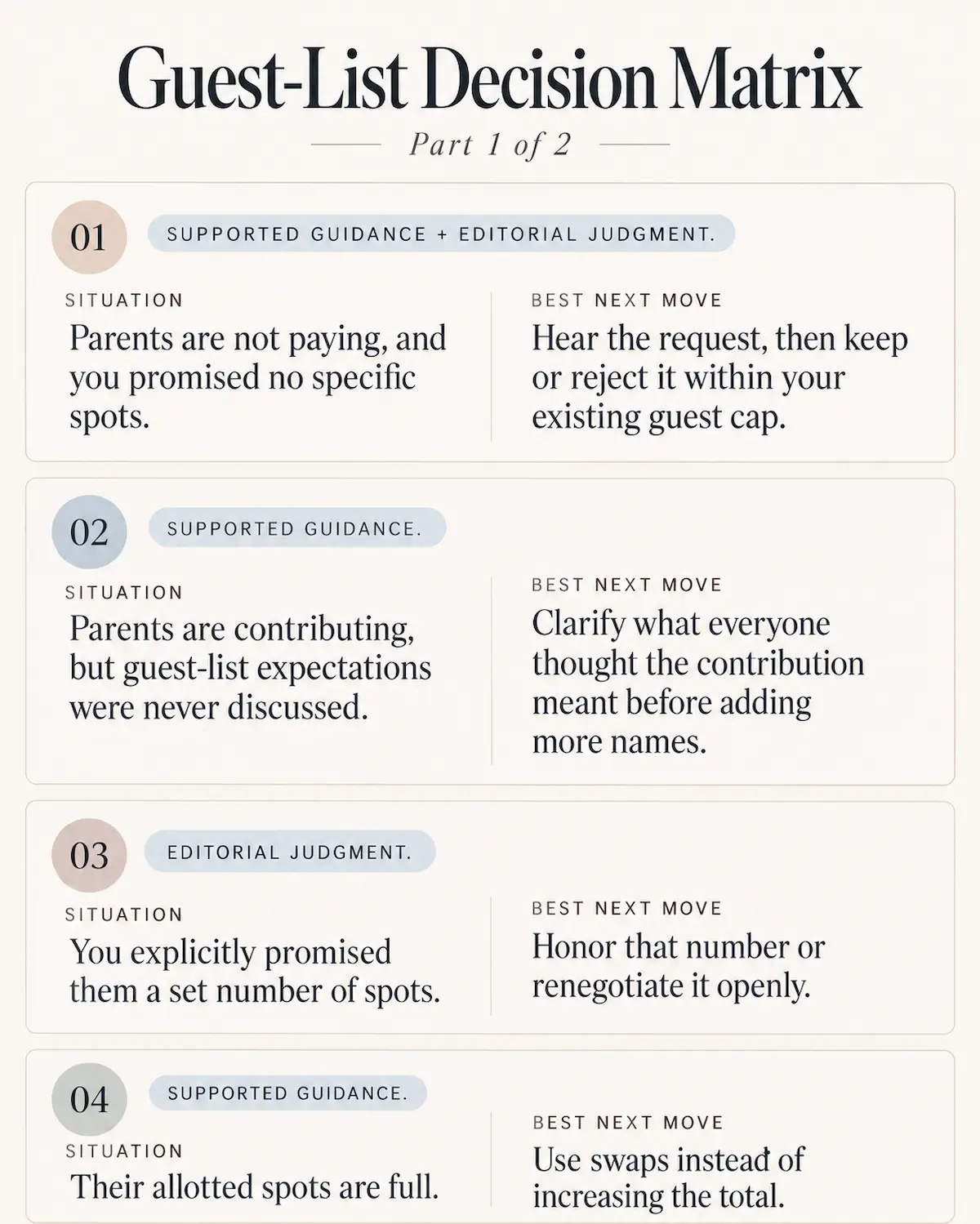
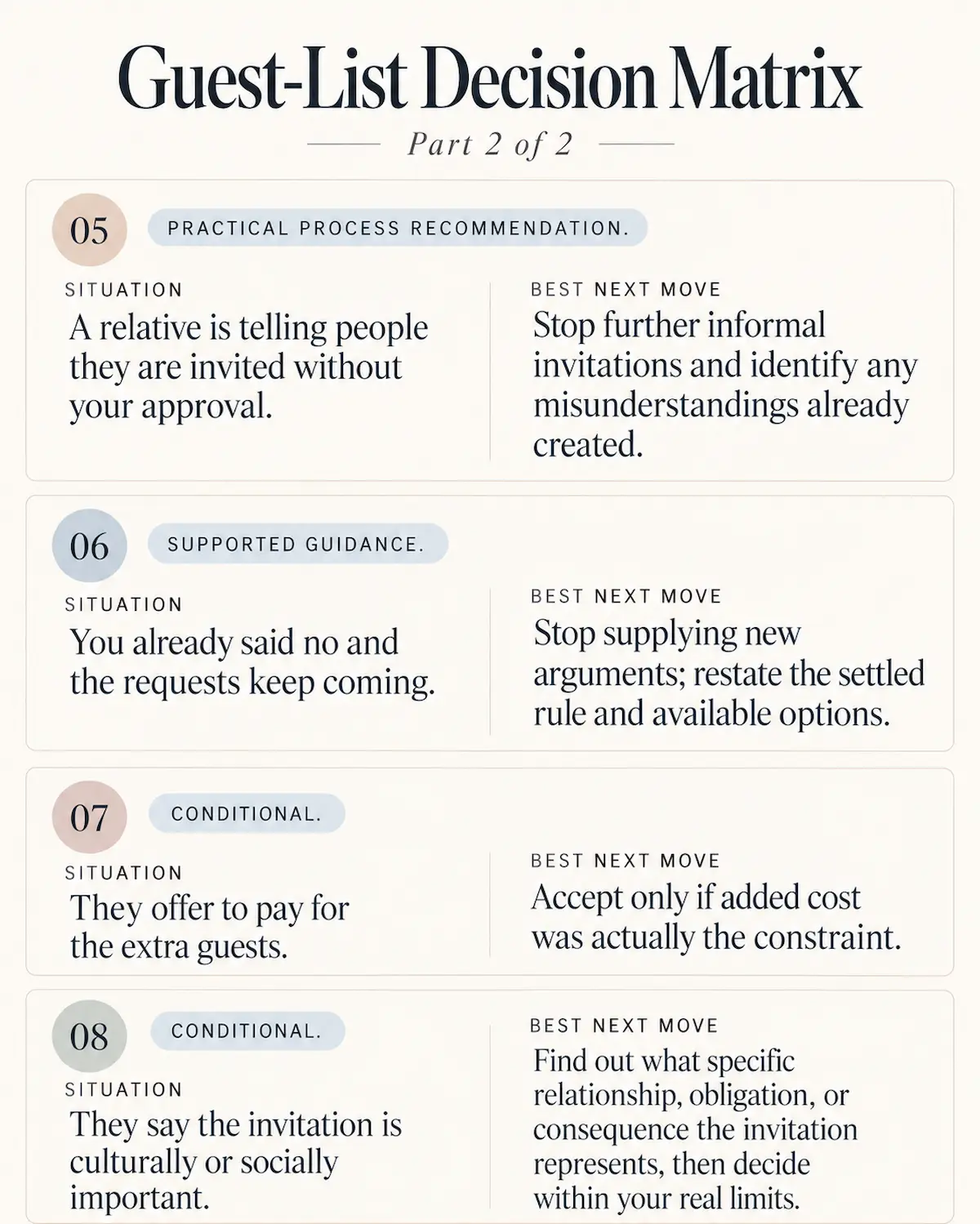
| Situation | Best next move |
|---|---|
|
Parents are not paying, and you promised no specific spots. Supported guidance + editorial judgment. |
Hear the request, then keep or reject it within your existing guest cap. |
|
Parents are contributing, but guest-list expectations were never discussed. Supported guidance. |
Clarify what everyone thought the contribution meant before adding more names. |
|
You explicitly promised them a set number of spots. Editorial judgment. |
Honor that number or renegotiate it openly. |
|
Their allotted spots are full. Supported guidance. |
Use swaps instead of increasing the total. |
|
A relative is telling people they are invited without your approval. Practical process recommendation. |
Stop further informal invitations and identify any misunderstandings already created. |
|
You already said no and the requests keep coming. Supported guidance. |
Stop supplying new arguments; restate the settled rule and available options. |
|
They offer to pay for the extra guests. Conditional. |
Accept only if added cost was actually the constraint. |
|
They say the invitation is culturally or socially important. Conditional. |
Find out what specific relationship, obligation, or consequence the invitation represents, then decide within your real limits. |
Notice what is not in that table: a universal percentage of invitations that parents are entitled to.
You will see tidy formulas in wedding advice—give each family a third, give parents ten percent, divide everything proportionally. Those formulas can be useful if your family agrees to them. They are not universal etiquette rules.
A number becomes useful when everyone understands and accepts it. Until then, it is just arithmetic wearing a blazer.
If Your Parents Aren’t Paying—and You Never Promised Them Guest Spots
This is the cleanest version of the problem.
If you and your partner are funding the wedding and you never promised your parents a specific guest allotment, their additions are requests. You can consider them. You do not have to adopt them.
That does not mean you need to respond with, “You aren’t paying, so you get no opinion.” Efficient? Yes. Good family diplomacy? Less so.
A parent may still care deeply about having a sibling, old family friend, or important relative included. You can take that concern seriously without turning the guest list over.
Try: “We’ve finalized the number we can host, so we aren’t adding more names. I know these people matter to you, but we need to keep the list within the group we’ve chosen.”
If you do have room and genuinely want their input, give them a number.
Not: “Send me anyone you’d like invited.”
Try: “We have space for four people you’d especially like included. Send us your four names by Friday.”
Open-ended guest-list permission is where innocent phrases go to become administrative disasters.
If Your Parents Are Contributing Money, Find the Missing Agreement Before You Fight About Names
This is where “your wedding, your rules” becomes too flimsy to be useful.
Wedding money has an annoying habit of arriving with invisible terms and conditions.
One parent may think, “We are giving you money because we love you.” The couple hears: gift.
The same parent may also think, “Obviously that means our closest friends will be invited.” They hear: participation.
Nobody says either part aloud. Then everyone is furious over names and acting as though the other side changed the rules.
If your parents are helping financially but nobody ever discussed what that meant for the guest list, do that now. Do not pretend the money automatically gave them unlimited invitation rights. Also do not pretend their expectations are irrelevant if you accepted a contribution without ever asking what they expected in return.
Try: “We’re really grateful for your contribution, and I think we skipped an important conversation. Before we add anyone else, can we agree on what guest-list involvement you expected when you offered the money? We can accommodate a defined number; we can’t leave the list open-ended.”
The goal is to turn an implied bargain into an explicit one.
That might mean they receive a fixed allotment. It might mean they can suggest people while you and your partner still approve the final list. It might mean everyone agrees that the contribution does not change guest-list decisions.
The exact arrangement can vary. The useful part is making it visible.
If the conditions attached to the money are unacceptable, that becomes a larger financial decision: whether keeping the contribution is worth accepting those conditions.
If You Already Promised Them a Number of Guests, Treat That Promise Like an Agreement
This is the scenario a lot of boundary advice flattens.
Say you told each set of parents, “You each have 15 guest spots.” Your mother now hands you 21 names.
The answer is not that she gets 21 because she asked confidently. But I also would not suddenly announce that parents get no say because it is “your wedding.” You already gave her 15.
My fairness judgment here is simple: honor the number you promised, or renegotiate it openly.
If circumstances have materially changed, you can revisit the agreement. Just call it what it is: a renegotiation.
Do not quietly change the deal and then describe the other person as unreasonable for noticing.
Try: “We promised you 15 spots and we’re keeping that commitment. Your current list has more than 15 people, so please send us the 15 you want most. If something changes with capacity, we’ll tell you before changing the agreement.”
Use swaps instead of additions
Once a parent’s allotment is full, stop debating every new name as a fresh moral dilemma.
The question becomes: “Who would you like to replace?”
Try: “Your 15 spots are full. If you want to include them, that’s okay, but tell us who you want to swap out. Our total isn’t increasing.”
A swap makes the tradeoff visible. “Just one more person” sounds tiny when someone else is absorbing the consequences. A swap puts the priority decision back with the person requesting the change.
If They’re Inviting People Without Permission—or Keep Asking After You’ve Said No
There is a meaningful difference between:
- “Could we invite Aunt Linda?”
- “I know you said the list is full, but could we reconsider Aunt Linda?”
- “I told Aunt Linda she’s invited.”
- “I added Linda, her husband, their adult children, and someone named Gary to the spreadsheet.”
The first is a request. The second may still be a negotiation. The third and fourth are process problems.
If they are telling people they are invited
You need one authoritative guest list. Otherwise every family conversation can become a ticketing office.
Try: “Please don’t tell anyone they’re invited unless we’ve confirmed their name. We’re working with a fixed list. If someone has already been told they are invited, please let us know today so we can decide how to handle the misunderstanding.”
If your relative created the misunderstanding, it is reasonable to ask them to help correct it. You do not have to automatically turn every unauthorized promise into an invitation.
If you have already said no more than once
Stop writing a new legal brief every time the question returns.
More explanation can make a settled decision look negotiable again.
Try: “We’ve already made the decision on additional guests, so we aren’t reopening the total. If you want to swap someone within your existing spots, send us the change by Friday. Otherwise the list stays as it is.”
That script does not contain twelve reasons, a defensive apology, or a debate over whether the newly suggested person is sufficiently wedding-worthy.
You already decided the total. Keep the conversation about the process.
For future in-laws, let the partner with that family relationship lead
If the pressure is coming from your partner’s parents, it can be useful for your partner to lead that conversation while you both stand behind the same decision.
That does not mean your partner gets to say, “She won’t let me invite them.” Nothing turns a guest-list disagreement into long-term family mythology faster than making one partner the villain.
The message is “we decided,” even if one person delivers it.
“We’ll Pay for Them” Doesn’t Automatically Answer the Question
Sometimes the conflict seems financial:
“We can’t add more people.”
“Fine. We’ll pay for them.”
Problem solved? Maybe.
Ask what your objection actually was.
- If the only issue was added expense, extra funding may solve it.
- If the venue cannot accommodate more people, money does not create more capacity.
- If you want an intimate wedding, covering the added cost does not change the size of the event.
- If adding their people means removing people you are closer to, the tradeoff still exists.
- If every addition creates another round of additions, the problem is the open-ended process, not one catering bill.
Do not accept a financial solution until you know whether you actually have a financial problem.
If money is not the real constraint, say so.
Try: “Thank you for offering. Cost isn’t the only reason we’re keeping the number where it is—the size of the wedding itself matters to us. We aren’t increasing the total, even if those additional guests are paid for.”
When Culture, Reciprocity, or Family Reputation Is Part of the Guest List
This deserves more care than either of the usual reactions: “Culture doesn’t matter; invite who you want,” or, “It’s tradition, so obviously you have to do it.” Neither tells you what the actual obligation is.
In some families, a requested guest may represent an elder relationship, a long-standing social tie, reciprocity, or another meaningful family expectation. That does not automatically make the answer yes. It does mean the concern deserves to be translated into something more specific than, “But we have to invite them.”
Try: “I want to understand why this invitation matters. Is this someone you’re personally very close to, an elder relationship, a reciprocity expectation, or something that would create a real family consequence if they weren’t invited? Tell me that part so we can make the decision with the full context.”
Once you know what the invitation represents, you can make an actual decision.
You may decide the relationship matters enough to adjust something else. You may decide the obligation is real but still cannot fit within the venue or budget. You may decide the expectation matters deeply to your parents but does not outweigh your own guest priorities.
The useful move is curiosity first, decision second.
“Culture” should not become a magic word that ends the discussion in either direction.
Do This Tonight: A 20-Minute Guest-List Reset
If your guest list is currently being negotiated one text message at a time, stop.
You need a system small enough to explain in one conversation.
-
Agree on the absolute guest ceiling with your partner.
Use the number your event can realistically accommodate, not the number that would make every relative stop complaining.
-
Write down every promise you already made.
If you told a parent they had a specific number of spots, include it. Memory gets suspiciously creative during family arguments.
-
Count how many of each parent’s existing spots are already used.
Do this before discussing another requested name.
-
Clarify whether family money came with guest-list expectations.
If nobody discussed that, the problem is not solved by pretending you did.
-
Decide whether new names are additions or swaps.
Once an allotment is full, I would default to swaps. Otherwise “one more” never has to compete with anything.
-
Decide who communicates with each side of the family.
When it fits your family dynamic, each partner can lead communication with their own parents while both of you stand behind the same decision.
-
Set one deadline for final parent changes.
The guest list needs a point at which it stops being a living organism.
-
Send one clear message.
Use the script that matches your situation. Keep it shorter than your instinct tells you.
-
After the rule is settled, stop relitigating individual names.
If the only available option is a swap, the conversation becomes, “Who would you like to replace?” Not another summit.
Your goal is not to make every relative agree that your guest-list rule is fair. Your goal is to create a rule that you and your partner can explain, follow, and stop renegotiating every three days.
That is the part generic “set boundaries” advice tends to skip. A boundary with no operating system behind it becomes another conversation. Then another conversation. Then, somehow, Gary is on the list again.
When This Is Bigger Than One Guest-List Argument
If this really is one disagreement about one or two people, you probably do not need a 257-page workbook. Use the framework above, send the message, and move on.
If the guest list is only one part of a larger pattern—repeated family pressure, conflicting expectations on both sides, difficulty holding a decision after you make it, relatives interfering in other wedding choices, or concern about managing the same dynamics on the wedding day—you may want something more structured.
The Wedding Boundaries Workbook for Brides is a fillable digital workbook focused on wedding-family conflict. It includes 50+ communication scripts, couple-alignment planning, consequence and escalation tools, delegation and information-limit exercises, and day-of protection planning.
It is an implementation tool, not a magic relative-repair device. It cannot guarantee that somebody will respect a boundary or react calmly, and it is not therapy, legal advice, or emergency support.
For this guest-list problem, though, you already have the free answer: identify the agreement, set the number, decide whether additions are really swaps, and stop reopening a decision that is already closed.