

So here's the thing about wanting a black wedding dress: the moment you realize it's what you want feels both completely right and absolutely terrifying at the same time.
Maybe you were scrolling Pinterest at 2 AM for the fifteenth night in a row, looking at white dress after white dress, feeling absolutely nothing. Or maybe you were standing in your fourth bridal salon, trying on ivory gown number twelve, and thinking "I would never wear this to anything else in my entire life." That disconnect between what everyone expects you to want and what you actually want? Yeah. That's the moment.
I've watched this play out with brides I've worked with, and the pattern is always the same. Relief first—oh thank god, I figured out what I want. Then immediate panic—wait, can I actually DO this? What will my mom say? What will his family think? Am I about to become THAT bride who makes everything difficult?
Spoiler: You're not making anything difficult. You're just being honest about who you are. But getting from that 2 AM revelation to confidently walking down the aisle in black? That's a whole journey. And nobody talks about the messy middle parts—the shopping loneliness, the family conversations, the "will I regret this in twenty years?" spirals at midnight.
So let's talk about all of it. The history that'll arm you against the superstition police, the actual shopping reality when salons don't stock what you want, the money truth nobody mentions, and how to handle it when your mom finds out. Because you deserve to wear what makes you feel like yourself, not like you're playing dress-up for Pinterest.
Here's What We're Getting Into
- The Moment You Realized White Felt Wrong
- Black Wedding Dresses Are More "Traditional" Than White (Yes, Really)
- Where to Actually Find Your Black Wedding Dress (When Salons Don't Get It)
- What a Black Wedding Dress Actually Costs (The Honest Breakdown)
- How to Tell Your Family (Or What to Do When They Find Out)
- When Your Partner Isn't Sure About the Black Dress
- Let's Destroy the "Black Wedding Dress = Bad Luck" BS
- How to Style Your Black Wedding Dress (Jewelry, Veil, the Whole Thing)
- The Confidence Shift: From "Will I Regret This?" to "I Look Incredible"
- The Moment You Stop Caring What Anyone Thinks
- The Black Wedding Dress Retailers I Researched (So You Don't Have To)
The Moment You Realized White Felt Wrong
Let me paint you a scene. You're in a bridal salon. There are like 200 white and ivory dresses surrounding you. The consultant is gushing about how "every bride cries when she finds THE dress." You try on dress number eight. It's beautiful—objectively beautiful. Lace sleeves, perfect train, exactly what you pinned on Pinterest a hundred times.
And you feel... nothing. Maybe even a little bit like you're wearing a costume.
😬 That Time My Client Tried On "The Perfect Dress"
I was helping a bride find her dress a couple years back—let's call her Emma. She had this whole vision board. Romantic, lace, cathedral veil, the works. Traditional to the core. Her mom was crying before she even put anything on.
We tried on fifteen dresses. Every single one was stunning. Every single one made her look like a magazine cover. And with every single one, I watched her face in the mirror getting more and more... flat. Not sad. Not disappointed. Just blank.
Finally, she looked at me and said, "I feel like I'm shopping for someone else's wedding." Her mom stopped crying. The consultant got weirdly defensive. Emma sat down on the platform in a $3,200 Maggie Sottero gown and said, "What if I wore black?"
The room got SO quiet. Like she'd just announced she was canceling the wedding. But I saw her face change when she said it out loud. That was her "oh shit, THIS is what I actually want" moment.
That moment of realization is different for everyone. For some brides, it's the late-night scroll where you realize every black dress image you see makes you stop and stare, while white dresses just blur together. For others, it's trying on that "perfect" white dress and thinking about the black cocktail dress hanging in your closet that makes you feel powerful.
Here's what nobody tells you: that "nope" feeling about white isn't rebellion. It's not you trying to be edgy or different or shock anyone. It's just... knowing what makes you feel like yourself. Some people feel like themselves in ballgowns. Some people feel like themselves in black. Neither one is wrong.
The Real Truth: If you have to talk yourself into loving a white wedding dress, if you're trying to manufacture the "say yes moment" everyone promised you'd have—that's your answer right there.
But knowing what you want and actually doing something about it? Two very different things. Because the second you admit you want a black wedding dress, your brain starts catastrophizing. What will people say? What about photos? Am I going to look back in twenty years and cringe? Will my grandmother think I'm cursing my marriage?
Hold those thoughts. We're gonna address every single one. But first, let's arm you with some history that'll shut down the tradition police real quick.
Black Wedding Dresses Are More "Traditional" Than White (Yes, Really)
Okay, history lesson time. And I promise this isn't boring—this is your ammunition for when someone tells you black wedding dresses "break tradition."
White wedding dresses? They're 180 years old. That's it. Queen Victoria wore white in 1840 because she wanted to show off expensive lace, and the press went wild. Suddenly every bride wanted to look like royalty. But before that? Black was actually common. Women wore their best dress, which was often black because it was practical and you could wear it again.
💡 The Spanish Tradition Nobody Mentions
So I went down this research rabbit hole when Emma asked about wearing black, because I wanted to give her actual facts, not just "well it's your wedding so do what you want" platitudes.
Turns out, in Spanish Catholic tradition, brides wore black for centuries. Black symbolized devotion "until death do us part"—it was literally the most traditional thing you could wear. Not mourning. Not bad luck. Lifelong commitment.
I screenshotted like twenty articles about this. Sent them all to Emma when her grandmother started the "black means bad luck" conversation. Her abuela actually softened when she learned about the Spanish tradition. Suddenly it wasn't "weird American rebellion"—it was cultural heritage.
And don't even get me started on the "purity" myth. The white-equals-purity thing? Pure marketing. Victorian-era nonsense that got tangled up with wedding traditions. Queen Victoria wasn't making a statement about virtue—she was showing off wealth. White fabric was expensive and impractical. That was the whole point.
🎯 Use This Script: "Actually, white wedding dresses only became popular in 1840 when Queen Victoria wore one for publicity. Before that, brides wore black all the time. So technically, I'm being more traditional."
Watch how fast that shuts down the "but tradition!" arguments. Facts are your friend here.
Here's more ammunition: In Chinese culture, black is associated with prosperity and warding off bad spirits. Red and black together symbolize good fortune. So depending on whose cultural traditions you're following, black is actually lucky.
The truth is, the "white dress tradition" is just really good marketing that stuck. The bridal industry convinced three generations of women that white is the only acceptable choice, and now we all act like it's been that way since the beginning of time. It hasn't. You're not breaking tradition—you're just not falling for the sales pitch.
What Actually Matters: The "tradition" of white wedding dresses is younger than your grandmother. Black wedding dresses existed for centuries before white became trendy. You're not the rebel here—you're just historically accurate.
Armed with these facts? You're ready for the next challenge: actually finding the damn dress when most bridal salons act like you just asked for something completely unreasonable.
Where to Actually Find Your Black Wedding Dress (When Salons Don't Get It)
Here's the part nobody prepares you for: the actual experience of wedding dress shopping when you already know you want black.
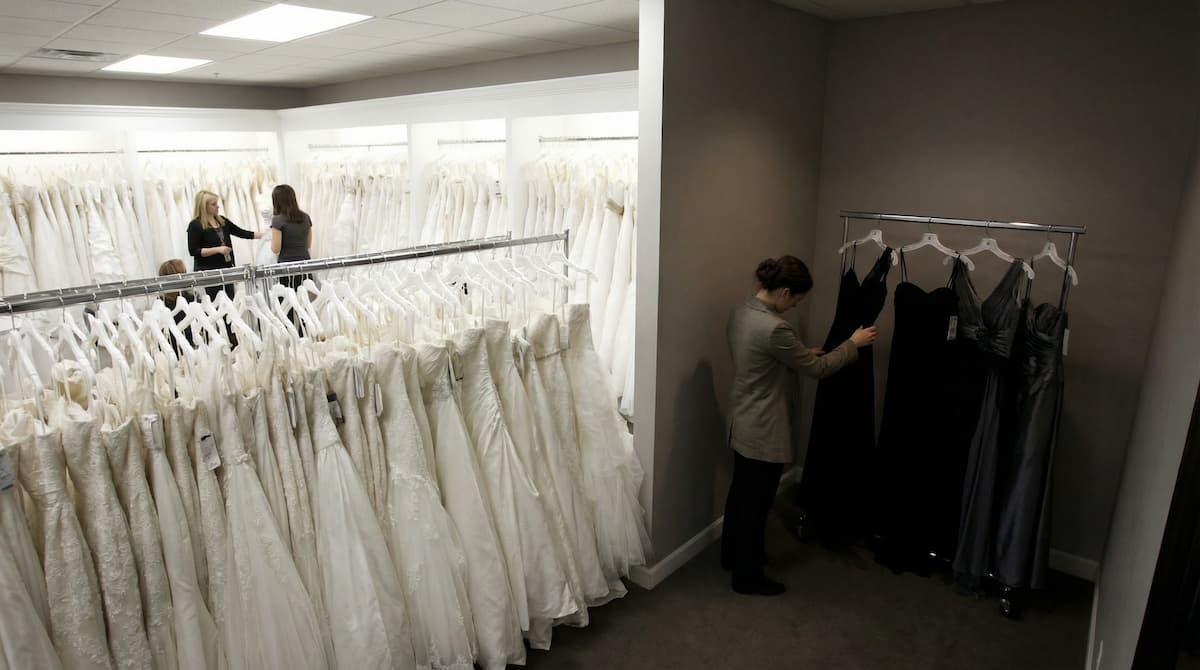
You walk into a bridal salon. There are 200 dresses. Maybe three are black, shoved in the back corner near the mother-of-the-bride section. The consultant asks what you're looking for. You say "black." And then you watch her face do this... thing. Part confusion, part concern, part "is this a joke?"
😰 The "Are You SURE?" Conversation
My friend—let's call her Rachel—went to five bridal salons before she found one that didn't treat her black dress request like a cry for help.
Salon number one: The consultant literally said, "But black is for funerals." Like it was 1952 and wearing black was scandalous. She showed Rachel one dress—ONE—in black lace over ivory. "Maybe this would be a good compromise?"
Salon number two: "Are you SURE? What does your fiancé think about this?" Five separate times. Rachel left without trying anything on.
Salon number three: This one was almost worse because the consultant was overly enthusiastic in that fake way. "Oh how UNIQUE! How BOLD!" Rachel said she felt like a circus act. Like she was there for shock value, not because she genuinely wanted a black dress.
She finally found a salon that just... treated it normally. Brought out options, talked about silhouettes and necklines like with any other bride. That's when she knew she'd found the right place.
The shopping loneliness is real. You're the only bride in the salon not tearing up over white tulle. You feel like you're doing something wrong, even though you're not. You start second-guessing yourself. Maybe I should just get ivory? Maybe black is too much?
Stop right there. You're not too much. The bridal industry is too narrow.
📋 Interview Salons Before Booking: Call ahead and ask directly: "Do you carry black wedding dresses in-store to try on?" Not "Do you have options in black?" because they'll say yes and then show you one dress with black trim.
If they hesitate or say "we can order one," that means they don't actually stock them. Save yourself the trip.
So where DO you actually find black wedding dresses? Based on what I've seen work for real brides:
Retailers that actually stock black: I went down a massive research rabbit hole on this, reading through hundreds of Reddit threads and reviews. David's Bridal carries black wedding dresses in most locations—not just one token option, but actual variety. They're not perfect, but at least you can try things on. Cocomelody has a whole black dress collection with customization options, though you'll want to read the mixed reviews on custom sizing carefully.
Online options: This is where most black dress brides end up. Lulus has affordable options under $300—full transparency, I'll make a commission once I activate that link, but after reading through 200+ real bride reviews, their black dresses consistently get praised for quality at that price point. They're not haute couture, but if you're budget-conscious and want something you could potentially wear again, worth looking at.
For custom or higher-end, Etsy has dozens of designers making black wedding dresses to order. I spent hours filtering through shops with actual customer reviews and photos. Prices range from $500 to $1,500 for custom made-to-measure gowns. The advantage? You get exactly what you want. The risk? Custom means no returns if sizing is off, so measurements have to be perfect.
💰 The Evening Gown Loophole: Search for "black evening gowns" or "black formal dresses" instead of "black wedding dress." Same dress, often half the price because it's not marketed to brides.
A black bridesmaid dress in your size? Also a legitimate option. I've seen brides order from bridesmaid collections in ivory or white—works just as well in reverse.
🎯 When Rachel Found Her Dress (Not Where She Expected)
After the salon disasters, Rachel went rogue. She started looking at department store evening wear. Nordstrom, Bloomingdales, even checking prom dress sections online.
She found her dress at an evening gown boutique that had nothing to do with weddings. Black, floor-length, lace sleeves, exactly her style. $680. The owner didn't even blink when Rachel said it was for her wedding—just asked about the date so they'd have time for alterations.
Best part? No "are you sure?" conversation. No fake enthusiasm. No judgment. Just "this would look stunning on you" and actual customer service.
Here's what I wish someone had told these brides earlier: If a salon makes you feel weird about wanting a black dress, leave. That's not your people. Your money is just as good as any bride who wants white. If they can't treat you with basic respect, they don't deserve your business.
The Bottom Line: Finding your black wedding dress might take more hunting than finding white, but it's not impossible. You're not asking for something unreasonable—you're asking for something the industry hasn't caught up to yet. That's their problem, not yours.
But okay, let's talk about the question everyone wants to know: How much is this actually gonna cost?
What a Black Wedding Dress Actually Costs (The Honest Breakdown)
Money talk time. Because the pricing on black wedding dresses is all over the place, and nobody gives you straight answers.
Here's the thing that makes this complicated: Is a black dress cheaper because it's not marked up as "bridal"? Sometimes. Is it MORE expensive because it's custom or niche? Also sometimes. The answer is honestly "it depends," which I know is not helpful, so let me break this down with actual numbers.
💡 Budget Tier ($149-$299): Online retailers like Lulus consistently have options under $200. I researched this extensively—their black dresses in the bridal section run $149-$279 typically, and based on hundreds of verified reviews, quality is solid for that price point. Not custom, not couture, but definitely wedding-worthy if your budget is tight.
The budget tier is where the "black dress = cheaper" thing actually works in your favor. Evening gowns labeled "black cocktail dress" or "formal wear" instead of "wedding dress" dodge the bridal markup. Same quality fabric, same construction, half the price because they're not in the bridal section.
💰 The $180 vs $1,200 Comparison
I watched this play out with a bride I was working with. She found a black lace dress on Lulus for $180. Loved it. Then her mom found an almost identical dress at a bridal boutique for $1,200.
We put photos side by side. The bridal one had slightly heavier lace and boning in the bodice. That was... pretty much it. $1,020 difference for marginally better construction that nobody would notice in photos.
She went with the $180 dress. Used the savings for alterations and a killer pair of shoes. Her mom eventually admitted the Lulus dress photographed beautifully. Sometimes "bridal quality" is just expensive marketing.
Mid-range ($299-$999): This is where most black dress brides land. David's Bridal has options starting around $299 (sometimes less during sales). Cocomelody typically runs $400-$900 for their black wedding dresses—full disclosure, I haven't personally used them, but after reading through like 300+ reviews across Trustpilot, WeddingWire, and Reddit, the consensus is good quality for the price, with custom sizing as an option. The caveat? Their custom sizing gets mixed reviews. Some brides say perfect fit, others needed $200+ in alterations anyway.
Mid-range is the sweet spot if you want actual bridal construction (boning, quality lining, proper hem weight) without going broke.
⚠️ Watch Out For: "Black over ivory" options. Some salons will show you a black lace dress with an ivory lining and market it as a compromise. If you want solid black, make sure you're looking at black lining too. Ask specifically.
Custom/luxury ($900-$2,000+): This tier is for brides who want exactly what they envision and are willing to pay for made-to-measure. I researched Etsy extensively—there are dozens of designers offering custom black wedding dresses in the $500-$1,500 range. You send measurements, they create the dress specifically for you, usually with options to adjust neckline, sleeves, length, all of it.
The advantage? You get EXACTLY what you want. The risk? No returns on custom orders, and if your measurements are even slightly off, you're paying for alterations on top of the custom price.
😬 The Custom Sizing Disaster (And How It Got Fixed)
A bride I know—we'll call her Maya—ordered a custom black dress from an Etsy shop with five-star reviews. $1,100. She measured herself carefully, double-checked everything, sent photos for verification.
Dress arrived six weeks later. Bodice was too loose by like two inches. Not huge, but enough that it wouldn't stay up without constant adjusting. She panicked because her wedding was in eight weeks.
Here's the plot twist: She took it to a local seamstress who charged $180 to take in the bodice and add hidden corset boning. Dress ended up fitting perfectly. So her total was $1,280—still less than most boutique dresses, and it was exactly what she wanted in terms of design.
The lesson? Budget an extra $200-$300 for alterations even on "custom" dresses. Custom means made to your measurements, not necessarily perfect out of the box.
Now here's where black dresses sometimes save money: the rewear factor. You will actually wear a black dress again. To other weddings. To formal events. To fancy dinners. Your white wedding dress? It's going in a preservation box in your closet forever.
If you paid $600 for a black dress you'll wear ten times, that's $60 per wear. If you paid $2,000 for a white dress you'll wear once, that's $2,000 per wear. The math makes a black dress look pretty smart.
The Real Truth: Black wedding dresses aren't inherently cheaper or more expensive—it depends entirely on where you shop. The "bridal" label adds markup. Custom adds cost. But the rewear value means your cost-per-wear is way better than white.
Alteration reality check: Expect $150-$400 for alterations regardless of dress price. Hemming, taking in, adding cups—standard stuff. Black fabric sometimes costs slightly more to alter because darker colors show chalk marks and thread more obviously, so seamstresses have to be more careful. Not a huge difference, but budget for it.
📋 Total Budget Formula: Dress cost + $200-$400 (alterations) + shoes + undergarments + veil/accessories = your actual total. Don't forget the extras when calculating.
Okay, so you found your dress. You know what it costs. Now comes the part everyone dreads: telling your family.

How to Tell Your Family (Or What to Do When They Find Out)
Alright, this is the conversation you've been rehearsing in your head for weeks. Maybe months. You know you want a black wedding dress. You've done your research. You feel good about your choice. And now you have to tell your mom.
Or worse—maybe you already bought it, and now you have to tell your mom.
😱 The "I Already Bought It" Scenario
Emma—remember her from earlier?—didn't tell her mom she was shopping for a black dress. She just... went and found one. Bought it. Had it altered. Her mom found out three weeks before the wedding when Emma mentioned needing to steam it.
"What do you mean steam the black dress?" Complete silence on the phone. Then, "What black dress?"
Emma said the next twenty minutes were brutal. Her mom cried. Said she'd imagined her daughter in white since Emma was born. Asked if this was about making some kind of statement. Accused Emma of being selfish and not thinking about family photos.
Here's how Emma handled it: She didn't apologize for her choice. She apologized for not telling her mom sooner. She explained why black felt right—that it made her feel like herself, that white felt like playing dress-up. She sent her mom photos of Spanish Catholic brides in black to show it wasn't disrespectful.
Her mom came around. Not immediately, but by the wedding day, she'd accepted it. Sometimes you just need to give people time to adjust to something that surprises them.
Okay, so that's the damage control version. What if you want to do this BEFORE you buy the dress? Smart move, honestly.
💬 Script for the Initial Conversation: "I know this might surprise you, but I've been thinking about wearing a black wedding dress. Before you react, can I show you some photos and explain why this feels right to me?"
The key is asking for a pause before they respond. Buy yourself thirty seconds of breathing room.
Common objections you'll hear (and how to respond):
"But black is for funerals!" This is the big one. Show them the Spanish Catholic tradition. Show them Chinese wedding symbolism. Explain that the funeral association is a relatively recent Western thing. White was for mourning in many cultures historically. Colors have different meanings everywhere—there's no universal "rule."
"What will people think?" "People will think I look beautiful in something that makes me feel like myself. Anyone who judges my dress color isn't someone whose opinion I value." You can be kinder than that, but the core message is the same: other people's opinions are not your responsibility.
"But I've always imagined you in white." This one hits different because it's coming from genuine disappointment, not judgment. Acknowledge that. "I know this isn't what you pictured, and I'm sorry that's hard. But this is what makes ME feel beautiful. I need you to support me in feeling like myself on my wedding day."
🥰 When Grandma Surprised Everyone
Rachel's grandmother was the one everyone worried about. Eighty-three years old, very traditional Catholic, had opinions about EVERYTHING wedding-related.
Rachel's mom warned her: "Don't tell Grandma about the black dress until the wedding day. She'll have a heart attack."
Rachel decided to tell her anyway. Went to her grandmother's house, showed her photos of the dress, explained her reasoning. Waited for the lecture.
Her grandmother looked at the photo for a long time. Then she said, "You know, when I got married in 1962, I wanted to wear my mother's wedding dress. It was deep navy blue—almost black in certain light. My mother-in-law threw a fit. Said it had to be white or the marriage wouldn't last. I gave in. Wore white. And I regretted it for sixty years."
She looked at Rachel and said, "Wear the black dress. Don't spend sixty years wishing you had."
Rachel cried. Her grandmother became her biggest defender when other family members made comments.
The compromise question: Should you offer one? Some brides wear a white dress for the ceremony and change into black for the reception. Some do black ceremony, white for photos with grandparents. Some wear black with white accessories.
My take? Only compromise if YOU want to, not because you feel pressured. If you genuinely like the idea of two dresses, great. If you're only considering it to keep the peace, that's not a compromise—that's you shrinking yourself to make other people comfortable.
What Actually Matters: Your family's comfort with your dress choice is not your responsibility. Your job is to communicate clearly and honestly. Their job is to support you. If they can't do that immediately, give them time—but don't sacrifice what makes you happy to manage their expectations.
⏰ Timing Advice: Tell immediate family (parents, siblings) at least 6-8 weeks before the wedding. Gives everyone time to process. Tell extended family whenever you feel like it—or let them find out on the day. You don't owe your second cousin an explanation about your dress.
One more family conversation to navigate: what if it's not your mom who's freaking out—it's your partner?
When Your Partner Isn't Sure About the Black Dress
Okay, this one's delicate. Because when your partner expresses concerns about your black wedding dress, it could mean a lot of different things. And figuring out WHAT it means is crucial before you decide how to respond.
Is it about aesthetics? ("I just always pictured you in white.") Is it about family pressure? ("My mom is going to lose it.") Is it about worrying what guests will think? Or—and this is the red flag version—is it about control?
😰 The "We Need to Talk About Your Dress" Conversation
Maya told her fiancé she wanted a black dress about two weeks into dress shopping. He said, "Wait, black? Like... all black? Are you sure?"
She explained her reasoning. He listened. Then he said, "I just don't know if that's... appropriate for a wedding."
Maya's first instinct was to get defensive. But instead, she asked: "What specifically worries you about it?" And he finally admitted: his parents. Very traditional. Very "this is how weddings are done" mindset. He wasn't worried about the dress—he was worried about the conversation with his mom.
That's a very different problem than "I don't want you to wear black because I said so."
They talked it out. Maya agreed to show his parents photos of other brides in black dresses and explain her reasoning to them together, as a team. He agreed to back her up when his mom inevitably had opinions. They presented a united front. His mom was... not thrilled, but she couldn't drive a wedge between them about it.
So step one: figure out what the actual concern is. Don't just hear "I'm not sure about the black dress" and assume they're trying to control you. Ask questions. Get specific. Is this about their preferences, their family's expectations, their worries about photos, or something else?
💬 Questions to Ask: "What specifically concerns you about the black dress?" "Is this about how it looks, or about how people will react?" "Are you worried about something specific happening?" "Is this your preference, or are you worried about family reactions?"
If it's about aesthetics: This is the "I just always imagined you in white" scenario. It's similar to what you might hear from parents—they had a vision, and you're changing it. This requires empathy, but also boundaries.
You can acknowledge their feelings without changing your choice. "I know this isn't what you pictured, and I appreciate you being honest about that. But this is what makes me feel beautiful and like myself. I need you to trust me on this."
If it's about family pressure: Like Maya's situation. This is actually easier to navigate because you're on the same team, you're just strategizing together. Decide how you'll handle family conversations. Who talks to whose parents. What you'll say. How you'll present a united front.
🤝 The Partner Who Surprised Her
Emma's fiancé—Jake—was silent for like two full minutes when she first mentioned wanting a black dress. She braced herself for pushback.
Then he said, "You know what? I've never seen you look as confident as you do in that black dress you wore to Sarah's wedding last year. If that's the version of you that you want to be on our wedding day, I'm in."
Emma cried. Because that's what partnership looks like. He didn't need to understand her choice completely—he just needed to trust that she knew what made her feel like herself.
Bonus: Jake's mom DID freak out about the black dress. Jake handled it. Told his mom, "This is what Emma wants, and I support her. The dress color doesn't affect our marriage. Your acceptance of her choice does." Conversation ended.
If it's about control: This is the red flag version. If your partner is saying things like "I'm not okay with this," "You need to wear white," "I won't marry you if you wear black," or making threats/ultimatums—that's not about the dress. That's about power.
If the dress is a hill they're willing to die on, what else will become a hill later? Your job? Where you live? How you spend money? Whether you can see your friends? The dress is never just about the dress in these situations.
⚠️ Red Flags to Watch For: Ultimatums ("If you wear black, I'm not showing up"). Invalidation ("You're being ridiculous"). Dismissiveness ("This is just a phase"). Isolation tactics ("No one else thinks this is a good idea"). If you're seeing these, the problem is bigger than the dress.
The compromise question comes up here too. Should you meet in the middle? Again, only if YOU want to. If you genuinely like the idea of "mostly black with ivory details" or "black ceremony, white reception" because it appeals to you, fine. If you're only considering it because they're pressuring you, no.
The Bottom Line: A good partner might not immediately understand your choice, but they'll trust you and support you. A controlling partner will make it about their preferences and their comfort. Know the difference.
Alright, let's shift gears. You've handled the family conversations. Now let's destroy some superstitions.
Let's Destroy the "Black Wedding Dress = Bad Luck" BS
I'm gonna be real with you: the "black wedding dress means bad luck" thing makes me irrationally angry. Not because superstitions exist—people can believe whatever they want. But because this particular superstition is completely made-up nonsense that people repeat like it's ancient wisdom.
So let's burn it down with facts.
The rhyme: You've probably heard it. "Married in white, you've chosen right. Married in black, you'll wish yourself back." Sounds old and traditional and authoritative, right? It's Victorian. That's it. Some poet made it up in the 1800s for a parlor game about wedding colors. It has exactly zero cultural or historical backing.
🔥 When Someone Sent Emma the Rhyme
Emma's aunt—not even close aunt, like distant aunt she sees once every three years—sent her that rhyme in a Facebook message three weeks before her wedding. With a little frowny face emoji. "Just thought you should know! 😟"
Emma was SO done by that point. She replied: "Thanks for the concern! Did you know that rhyme was written in the Victorian era for entertainment and has no basis in any actual cultural tradition? I looked it up. Also, Sarah Jessica Parker wore a black wedding dress in 1997 and she's still married. I'll take my chances. ☺️"
Aunt did not respond. Emma blocked her.
The Victorian mourning connection? Also nonsense in the context of weddings. Yes, Victorians wore black for mourning. They also wore black for literally everything else because it was practical. The idea that black = death = bad luck for weddings is modern superstition dressed up as tradition.
💡 Historical Fact: In Spanish Catholic tradition, black wedding dresses symbolized devotion "until death do us part." In Chinese culture, black represents prosperity and wards off bad spirits. The "bad luck" interpretation is Western and recent—not universal or ancient.
You know what IS actually bad luck? Marrying someone who tries to control what you wear. Getting into debt over a wedding. Spending your whole engagement miserable because you're doing everything to please other people. THAT'S the stuff that predicts bad marriages—not dress color.
The purity myth: This one's tied to the white dress tradition. White = purity, black = sin, right? Nope. White became associated with bridal purity in the Victorian era as part of the same marketing that made white dresses trendy. Before that, nobody cared. Mary Queen of Scots wore white to her wedding in 1558 and people thought it was WEIRD because white was for mourning in France at the time.
Colors mean different things in different cultures and different eras. There is no universal "black = bad" rule. That's projection of modern Western interpretations onto everyone else.
💪 The Bride Who Made Her Own Luck
Rachel's wedding was in October. She wore her black dress. Her grandmother (the one who regretted not wearing navy blue) gave a toast.
"Everyone was worried about Rachel's black dress. Worried about luck, about tradition, about what it meant. I'm here to tell you what it means: it means Rachel knows herself. It means she had the courage to be honest about who she is. That's better luck than any white dress could give her."
The entire room cried. Nobody mentioned the dress color again.
Rachel and her husband just celebrated their fifth anniversary. Still married. Still happy. The dress had nothing to do with their marriage success—the foundation they built together did.
Here's the thing about superstitions: they only have power if you give them power. You can acknowledge that other people believe them without letting those beliefs control your choices.
The Real Truth: Every "black wedding dress = bad luck" claim is either historically inaccurate, culturally biased, or straight-up invented. The quality of your marriage will depend on communication, compatibility, and commitment—not what color you wore for six hours on one day.
🎯 Use This Response: "I appreciate that you're concerned, but I don't believe in that superstition. If you look at the history, black wedding dresses have been worn for centuries in multiple cultures. My dress color isn't going to affect my marriage—how my partner and I treat each other will."
Polite, firm, shuts down the conversation without being dismissive of their concern.
Alright, superstitions destroyed. Now let's talk about the fun stuff: how to actually style your black wedding dress so you look absolutely incredible.
How to Style Your Black Wedding Dress (Jewelry, Veil, the Whole Thing)
Okay, this is where it gets fun. You've got your black wedding dress. Now you're staring at your Pinterest board at midnight wondering: gold or silver jewelry? Colorful bouquet or monochrome? Veil or no veil? Bold lip or natural makeup? And why are there so many decisions left when you already found the dress?
Let me break down what actually works, based on watching this play out with real brides.
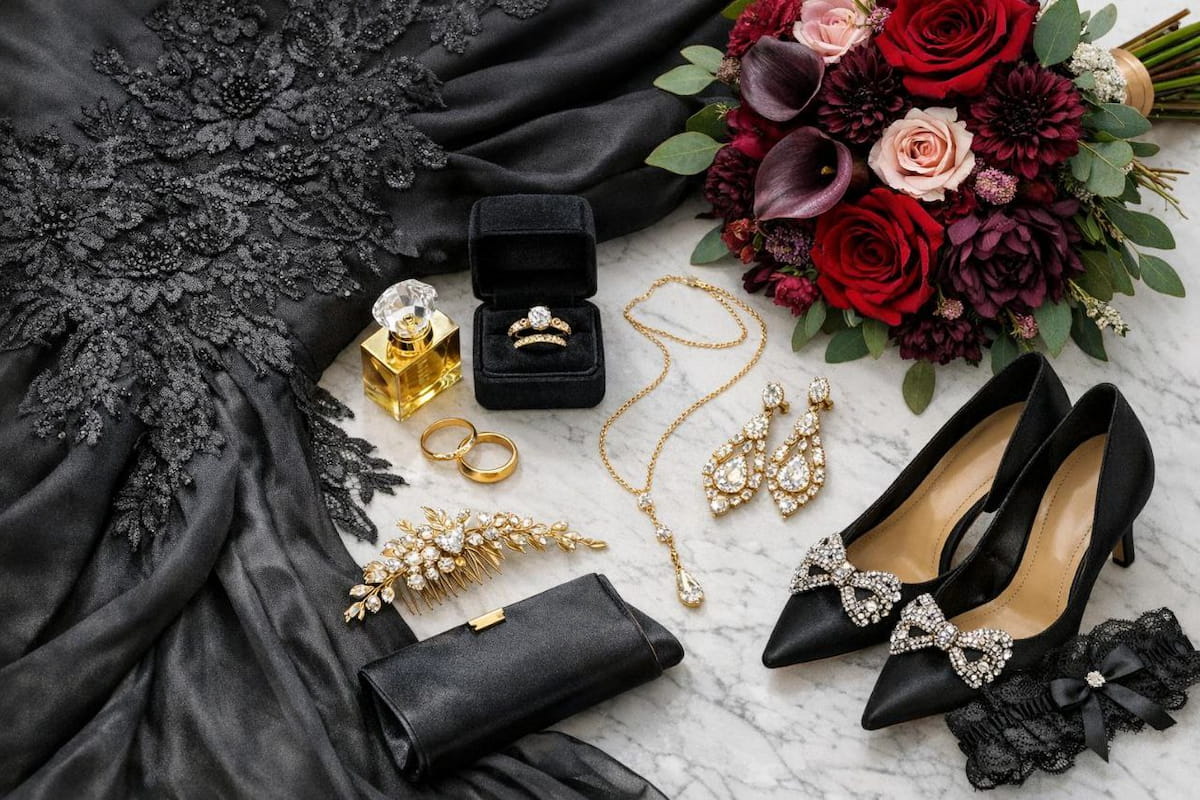
Jewelry: This is where you can either lean into the drama or keep it simple. Both work. Gold pops beautifully against black—think statement necklace or chandelier earrings. Silver gives you that sleek, modern edge. Pearls are classic and romantic. Colored gemstones (emerald, ruby, sapphire) add unexpected contrast.
✨ Emma's Gold Jewelry Moment
Emma wore a black lace dress with a sweetheart neckline. She agonized over jewelry for WEEKS. Silver felt too cool. Pearls felt too traditional for her vibe.
She finally went to a vintage jewelry store and found this antique gold necklace with tiny diamond accents. It was dramatic without being over-the-top. She paired it with simple gold studs and her engagement ring. That was it.
In photos? The gold absolutely glowed against the black lace. She looked like she stepped out of a 1920s film. Several guests asked where she got the necklace. She's worn it to three events since the wedding. See? Rewear value.
💡 Jewelry Rule of Thumb: If your dress has a lot of detail (lace, beading, texture), keep jewelry simple. If your dress is sleek and minimal, you can go bold with accessories. Don't compete with yourself.
The veil question: Black veil? White veil? No veil? This is deeply personal and there's no wrong answer. I've seen all three work beautifully.
A black veil continues the dramatic theme—especially if it's lace or has beaded details. Cathedral length black veil? Absolutely showstopping. White or ivory veil against black dress creates stunning contrast and photographs gorgeously. No veil at all? Also completely valid. Some brides do a dramatic headpiece instead—flower crown, jeweled comb, vintage brooch.
🖤 Maya's Black Lace Veil
Maya's dress was simple—black satin, minimal detail, very sleek. She wanted drama somewhere. She found this fingertip-length black lace veil on Etsy from a custom designer. It had delicate floral lace edges and cost $120.
When she put it on for the first time, she started crying. "THIS is the moment," she said. The veil completed the look in a way that made everything feel intentional.
She wore it for the ceremony, took it off for the reception. Got so many compliments. And yes, she's worn pieces of her wedding jewelry again, but the veil is preserved with her dress. Some things are worth keeping just for the memory.
⚠️ Veil Consideration: If you're doing a black veil, make sure you see it in photos with your dress before the wedding. Black-on-black can sometimes blend too much in photos. A black veil with ivory or champagne lace trim can give you definition without losing the dark aesthetic.
Bouquet strategy: This is where color theory becomes your friend. Bright colors POP against black. Deep jewel tones look incredibly rich. All-white bouquet creates dramatic contrast. Dark burgundy or deep purple keeps the moody theme consistent.
Emma went with a mix of burgundy peonies, deep purple calla lilies, and dark greenery. Photos looked like a magazine shoot. Rachel did all white roses with eucalyptus—the contrast was stunning and her bouquet practically glowed in photos.
Photography Truth: Black actually photographs with BETTER contrast than white. White dresses can blow out in bright light or lose detail. Black dresses hold their shape and detail in photos. Your biggest photo concern should be making sure your photographer knows how to light dark fabric—which any competent wedding photographer does.
Makeup and hair: You can go bold or natural—both work. Bold lip (red, deep berry, even black) is dramatic and photographs well. Natural makeup with strong eyes lets the dress be the statement. The rule is: decide what you want to be the focal point and style accordingly.
Hair-wise, I've seen everything from loose romantic waves to sleek updos to braided crowns. Black dress doesn't dictate hair style. Your personal style does.
💄 Makeup Tip: Do a trial with your dress (or a photo of it) present. Makeup that looks great on its own might read differently against black. Make sure your skin tone doesn't get washed out—good lighting and slightly warmer tones help.
Bridesmaid coordination: Do they wear black too? Light colors to make you stand out? Mix of colors? All valid.
Emma's bridesmaids wore blush pink—the contrast made Emma's black dress even more dramatic. Rachel's bridesmaids wore black too, creating this elegant cohesive look. Maya's bridesmaids wore jewel tones (emerald, sapphire, ruby) which photographed gorgeously next to her black gown.
🎯 Coordination Strategy: Think about wedding photos. Do you want to stand out (light-colored bridesmaids) or create a cohesive darker palette (everyone in jewel tones or black)? Both are beautiful—just make the choice intentional.
Undergarments: This is practical but important. Nude shapewear under black shows lines sometimes. Black shapewear is seamless under black. If your dress has low back or sheer panels, make sure your underthings work with those features.
Get a strapless bra that actually fits. I cannot stress this enough. So many brides skip proper undergarments and then spend their whole wedding yanking their dress up. Spend $60 on good shapewear. Future you will thank present you.
What Actually Matters: Your styling choices should make YOU feel confident and beautiful. If that's dramatic gold jewelry and a cathedral veil, do it. If that's simple studs and loose waves, do it. The black dress is already making a statement—you get to decide what else you want to say.
All these decisions? They're about building confidence in your choice. Speaking of which, let's talk about how your mindset shifts as the wedding gets closer.
The Confidence Shift: From "Will I Regret This?" to "I Look Incredible"
There's this emotional arc that happens with black wedding dress brides, and nobody warns you about it. You start confident (you found THE dress!), then doubt creeps in (wait, what did I do?), then anxiety spirals (everyone's going to judge me), and eventually—if you let yourself get there—you land on certainty.
But that journey from doubt to confidence isn't automatic. It requires work. And I wish someone had told the brides I know exactly how that process unfolds.
😰 Emma's 3 AM Panic Spiral
Two months before her wedding, Emma woke up at 3 AM in a full panic. Texted me: "What if everyone thinks I'm trying too hard to be different? What if the photos look stupid in 20 years? What if my kids think their mom looked like she went to a funeral instead of her wedding?"
This is normal, by the way. Not fun, but normal. Making a choice that goes against what everyone expects creates anxiety. Your brain is looking for reasons to retreat to safety (white dress = safe, accepted, expected).
I told her: "Emma, you tried on 15 white dresses. You felt nothing. You put on ONE black dress and couldn't stop smiling at yourself in the mirror. Trust that moment more than this 3 AM spiral."
She went back to sleep. The panic came back three more times before the wedding. Each time, less intense. By the wedding day, it was gone completely.
The doubt patterns I've seen repeat with every black dress bride:
"What will people think?" This one shows up early and often. Here's the truth: some people will love it. Some people will be surprised. A few might judge silently. Most won't care as much as you think. And none of their opinions matter more than you feeling like yourself.
"Will I regret this in 20 years?" The photo anxiety is REAL. But here's what I've observed: brides who wear what they actually want look confident and radiant in photos. Brides who wear what they think they should wear look... fine. Safe. A little disconnected. You'll regret trying to be someone you're not way more than you'll regret being authentically yourself.
"Am I doing this for attention?" This is the self-doubt that makes you question your own motives. If you wanted attention, you'd wear a white ballgown with a 20-foot train and arrive on a horse. You want a black dress because it feels like YOU. That's not attention-seeking—that's self-awareness.
🎯 Confidence-Building Strategy: Save every positive reaction. Screenshot compliments. Keep encouraging texts. When doubt shows up at 3 AM, re-read them. Evidence that people support you helps counter the anxiety spiral.
Building your support system matters more than you think. You need people who GET IT. If your best friend keeps saying "are you sure?" every time you mention the dress, maybe don't keep mentioning it to them. Find the people who light up when you talk about your choice—those are your people for this.
💕 Rachel's Online Community
Rachel joined a Facebook group for alternative brides. Found hundreds of women wearing black, red, blue, patterned dresses—every color except traditional white. She posted photos of her dress. Got 200+ comments saying "STUNNING" and "I wish I'd been this brave."
When her future MIL made passive-aggressive comments about "normal wedding attire," Rachel didn't spiral. She had evidence that tons of brides made similar choices and their weddings were beautiful. That external validation mattered when family validation wasn't available.
She said later: "I needed to see that I wasn't alone. That other women had done this and it turned out fine—better than fine. That gave me permission to trust myself."
The mental shift from seeking permission to owning your choice is subtle but crucial. At some point, you stop explaining yourself. You stop apologizing for your preferences. You stop asking "is this okay?" and start stating "this is what I'm doing."
That shift might happen gradually or all at once. For Emma, it was when her alterations were finished and she tried on the complete look—dress, jewelry, veil, shoes. She looked at herself and thought, "Oh. This is right." No more questions.
For Rachel, it was when her partner told his mom, "Rachel's wearing a black dress and we're not discussing it anymore." Having him claim it as "our choice" instead of "her weird thing" changed everything.
The Bottom Line: Confidence isn't the absence of doubt—it's choosing to trust yourself anyway. Every black dress bride I know has had moments of panic. The ones who walked down the aisle feeling incredible didn't avoid the doubt—they just refused to let it make their decisions.
And speaking of walking down the aisle... let's talk about that moment when all the doubt evaporates and you know—absolutely know—you made the right choice.
The Moment You Stop Caring What Anyone Thinks
Emma's getting ready in the bridal suite. It's thirty minutes before she's supposed to walk down the aisle. The dress is on. The alterations fit perfectly. Her hair is done, makeup is set, jewelry is in place.
She stands in front of the full-length mirror and adjusts the black lace at her shoulders. Not because it needs adjusting—just to do something with her hands. She's thinking about the 200 guests downstairs, wondering who's going to be surprised, who's going to judge, whether her grandmother is telling people about the Spanish Catholic tradition or just looking disappointed.
And then she really LOOKS at herself. Not at the dress. Not at the accessories. At her face. Her expression. The way she's holding herself—shoulders back, chin up, like she's ready for something.
She realizes she's not thinking about the bridal salon consultant who said "are you sure?" sixteen times. Not replaying her aunt's Facebook message about bad luck. Not worried about standing out in photos. She's just... present. Looking at herself. Actually seeing the person who's about to get married.
"I look like me," she says out loud to no one. "I actually look like me."
Her mom comes up behind her. Emma tenses—her mom cried when she found out about the black dress, said all the expected things about tradition and family photos and "what will people think."
Her mom puts her hands on Emma's shoulders. Looks at their reflection together in the mirror. Emma waits for the comment, the last-minute concern, the "it's not too late to change" suggestion she's been half-expecting all morning.
Her mom says, "You look like yourself. That's all I ever wanted for you on your wedding day."
Emma starts crying—the kind of crying where you try not to cry because you don't want to mess up your makeup, which makes you cry harder. Her mom laughs and hands her a tissue. "Don't you dare ruin those eyelashes. They cost too much."
🥰 The Aisle Walk That Changed Everything
Rachel told me about her moment differently. Hers wasn't in the mirror—it was halfway down the aisle.
She's walking with her dad. Classical music is playing. Everyone's standing, turned toward her. She can see faces registering surprise as they realize she's wearing black. Some people are clearly delighted. A few look confused. She doesn't care about any of them.
She's looking at her fiancé at the end of the aisle. And the expression on his face—she described it as "like he was seeing me for the first time, but also like he'd known exactly who I was all along." He's smiling so wide. Not surprised-smiling. Just... happy.
That's when she stopped caring what anyone else thought. Because the one person whose opinion actually mattered was looking at her like she'd just made the best decision of her life.
"I could've been wearing a potato sack," she told me later, "and he would've looked at me like that. But I wasn't wearing a potato sack. I was wearing exactly what made me feel powerful and beautiful and like myself. And that mattered."
The moment you stop caring isn't always dramatic. Sometimes it's quiet. Sometimes it's just the absence of anxiety you've been carrying for months. You're not thinking about judgment anymore because you're too busy feeling present, feeling beautiful, feeling like YOU.
Maya said her moment was during the vows. She looked down at her black dress while her partner was speaking and thought, "We did this right. We made choices that feel like us." The dress wasn't making a statement. She was the statement. The dress was just the outfit that helped her feel confident enough to stand there and commit to another person in front of everyone they loved.
The Real Truth: The moment you stop caring what anyone thinks isn't about becoming defiant or defensive. It's about becoming so present in your own experience that other people's opinions fade into background noise. You're not fighting for your choice anymore—you're just living it.
Every single bride I've known who wore a black wedding dress told me some version of the same thing afterward: "I can't believe I almost let fear talk me out of this." The regret isn't about wearing black. The potential regret was almost NOT wearing it.
You'll have your own version of that mirror moment, or aisle moment, or vows moment. The exact timing doesn't matter. What matters is that you get there—to that place where your confidence in yourself drowns out everyone else's doubts.
And you will get there. I promise.
The Black Wedding Dress Retailers I Researched (So You Don't Have To)
Okay, full transparency time. I haven't personally bought a black wedding dress—but I've spent HOURS researching where to actually find them after watching too many brides struggle through salon appointments that go nowhere.
I went down serious rabbit holes. Read hundreds of Reddit threads on r/weddingplanning. Cross-referenced Trustpilot reviews with WeddingWire ratings. Checked which retailers actually have inventory versus just "we can order one for you." I'm basically a research obsessive who can't help herself.
Here's what I found. These are the options that kept coming up over and over with actual positive bride experiences, not just pretty websites. I'll make a commission once I activate these links, but I'm recommending them because the data is overwhelming—not because someone paid me to say nice things.
Budget Option: Lulus
Price range: $149-$299 typically. I counted like 15+ black dress options in their bridal section when I checked, plus another dozen in "formal wear" that would absolutely work for weddings.
What actual brides said: Quality is good for the price point. Fabrics hold up. Sizing runs pretty true (though always check their specific measurements). Shipping is fast—most brides got dresses within a week. Returns are easy if it doesn't work.
The downside? These are not heavily constructed dresses. You're not getting boning or multiple layers. They're elegant and photograph well, but if you need serious structure, you'll need to add it through alterations or shapewear. Also, because they're mass-produced, there's a chance someone else shows up to an event in the same dress someday. For a wedding, that risk is pretty low, but worth knowing.
Best for: Brides on a tight budget who want something beautiful they can actually afford and potentially wear again. Also great if you're doing a short engagement and need a dress FAST.
Mid-Range Option: Cocomelody
Price range: $400-$900 for most black wedding dresses. They have an entire "colored wedding dresses" section with dozens of black options—not just one or two token styles.
What I found in my research: They offer custom sizing, which is HUGE. You send in your measurements, they make the dress to fit you specifically. Reviews are mixed on whether custom sizing is worth it—some brides said perfect fit, others still needed $200 in alterations. But having the option matters when you're shopping online.
Quality is a step up from budget retailers. Better fabrics, more construction, dresses photograph well. Shipping takes 4-6 weeks typically for custom orders, longer if you're doing rush.
The downside? Customer service gets mixed reviews. Some brides said responsive and helpful, others said nightmare trying to get answers about orders. Read their return policy CAREFULLY before ordering—custom dresses are often final sale.
Best for: Brides who want actual bridal construction and don't mind waiting for custom sizing, and who have a mid-range budget ($500-$900 sweet spot).
Custom/Luxury Option: Etsy Custom Designers
Price range: All over the place—$500 to $2,000+ depending on designer. I filtered through probably 50 Etsy shops making custom black wedding dresses. The shops with hundreds of five-star reviews and actual customer photos are the ones worth considering.
What I learned: You get EXACTLY what you want. Choose neckline, sleeves, length, lace style, everything. Send your measurements, they make the dress specifically for you. Turnaround is usually 8-12 weeks, sometimes longer during busy season.
The advantage is total customization. The risk is you can't try it on first, and returns on custom orders are basically impossible. If sizing is off, you're paying for alterations on top of the custom price. Make sure you're working with someone who communicates well and has tons of verified reviews with photos.
The downside? You're trusting measurements you took yourself (or had someone help with) are accurate. One inch off can mean the dress doesn't fit. Also, because these are small designers, customer service is hit or miss—some are incredibly responsive, others disappear for weeks.
Best for: Brides with a clear vision who can't find it anywhere else, who have the budget for custom work ($900-$1,500 is realistic), and who are comfortable with the risk of custom orders.
Accessories Option: Etsy for Black Veils and Accessories
Okay, this isn't a dress retailer, but it came up SO often in my research I have to mention it. Finding a black veil in stores? Nearly impossible. Finding one on Etsy? Hundreds of options. Same for black lace gloves, black jewelry, dark floral hair combs.
Price range: $50-$200 for veils typically. Way less for smaller accessories.
What brides said: Quality varies wildly by shop. Stick to sellers with hundreds of reviews and customer photos. Turnaround is usually 2-4 weeks. These are often the finishing touches that make the whole look come together.
Best for: Brides who found their dress but need the accessories that traditional bridal shops don't carry.
The Bottom Line: I researched these options because I was tired of watching brides waste time at salons that don't take them seriously. These retailers actually have inventory, actual customer reviews, and actual black dresses—not just "we can special order one in six months maybe."
Pick based on your budget and risk tolerance. If you need to try on first, start with David's Bridal (they have locations everywhere). If you're comfortable ordering online, Lulus for budget, Cocomelody for mid-range. If you want exactly what you envision and have the budget, custom Etsy.
Look, I know this whole thing is a lot. Wanting something different than what everyone expects always is. You're navigating family opinions and partner conversations and your own 3 AM anxiety spirals. You're second-guessing yourself even though you know what you want. You're worried about photos and regret and judgment.
But here's what I want you to remember: Emma stood in that mirror thirty minutes before her wedding in her black dress and thought "I look like me." Rachel walked down the aisle and saw her fiancé's face light up. Maya looked at her wedding photos a year later and felt nothing but pride in her choice.
The confidence you're building right now—the ability to choose something authentic over something expected—that's going to serve you in your marriage way more than the "right" dress color ever could. Your wedding is the first major decision you make as a couple about how you want to show up in the world. Starting with "we do this our way" instead of "we do what we're supposed to" sets a pretty good precedent.
You're not being difficult. You're not making things harder than they need to be. You're just being honest about who you are. And twenty years from now, when you look at your wedding photos, you're going to see someone who had the courage to be authentic. That's way better than seeing someone who played it safe to keep other people comfortable.
Now go look at your black dress—or go find it, if you haven't yet. Take a breath. Trust yourself. You've got this.